As a parent or carer, you are best placed to help your child develop their speech, language, and communication skills. Here are our top tips to support your child.
Be Face to Face
Get on your child's level
Spend time being face to face with your child at their level. Try kneeling or laying on the floor during play to encourage eye contact.
Use facial expressions
Using facial expressions alongside words like ‘wow’, ‘sad’, or ‘happy’ can help make connections between words and real life experiences.
Make eye contact
Making eye contact is an early communication skill. Try getting on your child’s level and making eye contact while talking to them. You can also encourage eye contact by playing ‘peek-a-boo’!
Smile
Smiling is a great way to build your child’s non-verbal communication skills. Smile regularly when making eye contact and return your child’s smiles with enthusiasm!
Speak Clearly
Model good speech
Children pick-up speech from the people around them. Pronounce your words clearly and use full sentences to help them learn, even if they don’t yet understand everything you say.
Try not to speak too quickly
Give children time to learn the words you say by speaking slowly and clearly.
Avoid baby talk
Try not to use made-up words, like “are wu my widdle baby”, as tempting as it might be! Instead, use real words slowly and in a clear, high pitch.
Engage
Engage from birth
Start talking, making eye contact and using facial expressions as soon as your child is born. Children are learning about speech and communication from day one!
Show you are interested
Make time to respond to your child with enthusiasm. Showing interest helps them to learn about the back and forth of communication.
Actively look & listen
Actively listen and respond to your child. Make eye contact when they are making noises or speaking to you. This helps to build their understanding of communication and grows their confidence.
Limit distractions
Technology can be a great tool, but too much can distract children from learning speech, language and communication skills. Try setting ‘screen time’ limits, and promote language learning through fun activities.
Put your phone down
Adults can get distracted by technology too! Your child needs lots of time with you and without distraction to build their communication skills.
Respond
Value babble
Babble sounds are a stepping stone to language. Try translating your child’s sounds to show them that you are paying attention. For example, if your child looks at a car through the window and babbles, try saying ‘”oh look, there’s a car” while pointing yourself.
Introduce new words
Introduce new words by adding new words on to familiar things your child says. For example, if your child says “a car”, you could say “yes that’s right, it is a car. It is a BIG, BLUE, car!”
Talk at your child's language level
Read age-appropriate books with your child, and in everyday speech, try replying to your child using sentences that are a few words longer. For example, if they say, “sock off”, respond with “yes, we’re taking your sock off”
Repeat words
Repetition is key to making language stick. Try repeating songs you like singing together, or ask older children to repeat sentences back to you to check their understanding.
Make time to talk
Limit questions
Sometimes children can be overloaded with questions. Too many questions can inhibit language and communication. Try to comment rather than asking lots of questions and avoid closed ‘yes/no’ questions.
Give children time to think & respond
Give children extra time to process what you have said and to think of an answer. Listen well and wait
patiently.
Try not to interrupt
Children need extra time to process the things they have heard and to form their own words. Try not to interrupt their speech or thinking where possible.
Enjoy talking together
You can make talking together fun and enjoyable. Try playing games using words, and make learning new words enjoyable. Take a look at our activities for inspiration.
Inspire me!
What to do when the usual approaches don’t seem to be working
Every child is different – so if the usual approaches don’t seem to be working here are some more things to consider.
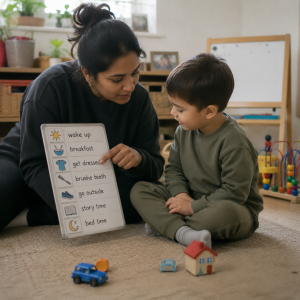 You can help your child understand what you are saying by keeping things really simple – and providing some visuals.
Choosing your words: speak slowly and clearly, and choose simple words. Sometimes, just one or 2 words might work best rather than a whole sentence e.g. ‘Finished….All gone!’
Getting your child’s attention: To help your child ‘tune in’ before you say anything to them, use their name first. It also helps to make sure you are at the same level, face to face.
Using objects: Choose an object to represent an activity, place or person e.g. shoes to represent going outside. Showing this to your child at the appropriate time will help them understand what you mean.
Explaining through pictures: help your child understand their daily routine by making a visual timetable of what will be happening. You could use objects that represent activities, real photos, or picture symbols.
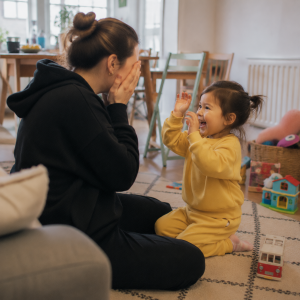 When children seem to be in a world of their own – or busily playing on their own – it can be hard to know how to connect. Here are some ideas to try.
Playing simple games together: Try fun, repetitive social games without toys, just you and your child. These could be games like peek-a-boo, tickle games, and songs with actions (like row row row your boat). Use lots of facial expressions and smile with your child!
Copying and mirroring: Copy things your child does like their facial expressions, sounds, words, and actions. This helps your child to feel that you are ‘sharing the moment’ and to take notice of you. Copying what they do when they are playing can also help them let you in to their play.
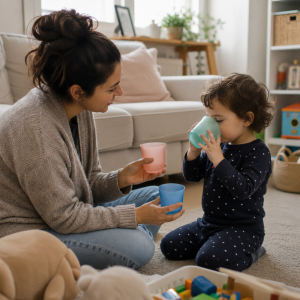 Even children who aren’t using their words yet have something to say and something to tell us. They might do this in different ways. This could be:
-
- leading you into the kitchen to show they want a snack
- repeating back something they have heard
- flapping their hands to show you they are enjoying something
- bringing you their bottle to show they want a drink
Here are some ideas for how to build on what they are already doing to help them communicate.
Offering choices: Give your child lots of choices throughout the day. Show your child two options and say them clearly (e.g., “juice or water?”). Accept your child’s choice even if they haven’t said the word (e.g., if they reach, point, or gaze at the object). Once they have made their choice, say the word clearly again when you give them the object.
Thinking about motivation and opportunities: Creating as many opportunities as possible for your child to communicate can really help.
Repeating simple words and phrases: Repetition is key to making language stick. Try repeating words and phrases at home like “help” “I want more” “I like that” that your child might copy.
Responding if your child repeats a word: Sometimes, your child might copy what you say. It’s good to respond when they do this and say ‘wow!’ or repeat the word they said. Sometimes your child may copy something they have heard word for word (it could be from anywhere – including a video they have seen). When children repeat back like this, it’s called echolalia.